
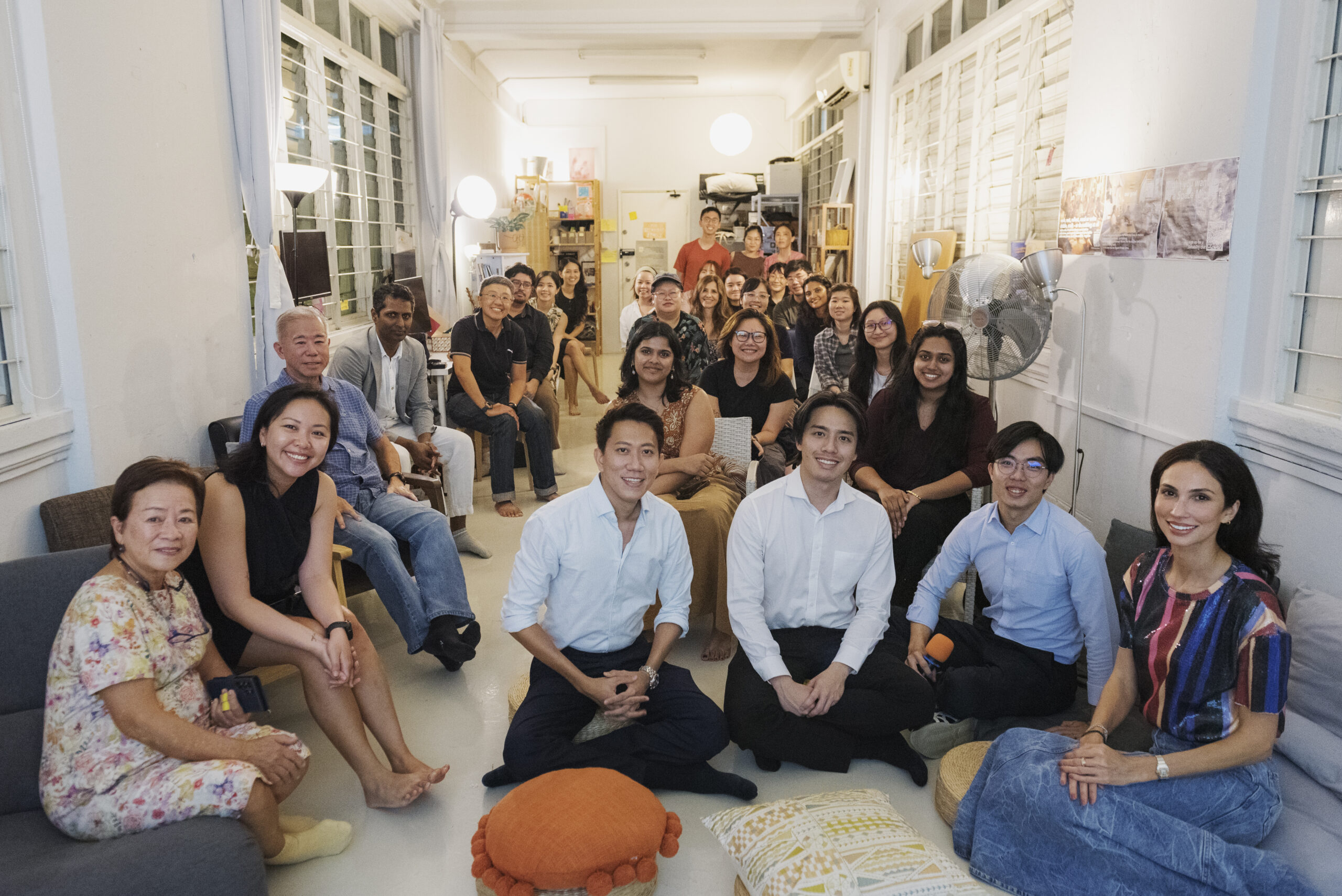
At a recent fireside chat, “Bridging Education Gap for Displaced Children” held on 26 March, the conversation began not with policy or statistics, but with a childhood memory.
By Fahimah Kadir
The session was moderated by Yuan Siang Ng, Co-Founder and Vice President of Monolith, and featured panellists including Brendan Tan, President and Co-Founder of Monolith; Dr Lai Ah-Eng, Associate at the Asia Research Institute; and Deborah Henry, founder of fugee.org. Together, they brought perspectives spanning social impact, youth advocacy, academic research, and frontline humanitarian work in the region.
A Different Kind of Migration
Deborah Henry recalled afternoons spent listening to her grandfather recount life during World War II. Those early stories sparked a quiet but persistent question: in a world of abundance, why do so many live with so little?
It is a question that would later shape her life’s work.
Unlike refugees, Deborah’s own family history was shaped by choice. Her father’s ancestors migrated from India to Malaysia, while her mother moved from Ireland to build a new life. Migration, in this sense, was an act of agency.
For refugees, however, movement is not a choice. It is a necessity for survival.

This distinction became real when she first met a refugee family in Kuala Lumpur while working with UNHCR. Living just minutes from the city centre, the children she met could neither read nor write.
What kind of future would they have?
That question marked the beginning of a journey into refugee education, one that would grow from a small, organic effort into a broader mission to reshape how we think about displacement in Southeast Asia.
Beyond Survival
Across Southeast Asia, refugees often live in relative peace but without legal recognition. In Malaysia, they are denied the right to work, have limited access to healthcare, and cannot enrol in the national education system. Without documentation, many live with the constant risk of detention.
The result is a prolonged state of survival.
But survival, as Deborah emphasised, is not enough. The real challenge lies in enabling refugees to thrive. This idea sits at the heart of fugee.org.
When Children Stop Dreaming
In the early days of the school, Deborah asked her students to draw their families, their favourite food, or their dreams. Many returned blank pages.
The moment revealed something deeper. Trauma and instability had not only disrupted education but had also diminished the children’s ability to imagine a future.
They were safe, but they could not dream.
Education, then, is not only about literacy. It is about restoring dignity, confidence, and the capacity to hope.


This was echoed by Dr Lai Ah-Eng, who noted that exclusion from education today has far-reaching consequences. Without it, individuals are shut out from opportunities and struggle to navigate an increasingly complex world. At the same time, she emphasised that education should not be seen as a single pathway.
A more holistic approach is needed, one that includes early education, alternative pathways, and vocational routes alongside higher education.
Gaps in the System
Today, the scale of the challenge in Malaysia remains significant. Of approximately 41,000 refugee children of school-going age, only 34% have access to any form of education, and most of these are informal, under-resourced learning centres.
Access becomes even more limited at the secondary level. Financial pressures, limited school capacity, and the need to support family income often led to early school dropouts. Without intervention, these risks creating a generation left without the tools to build stable futures.
The policy environment further complicates the issue. Refugees are not legally permitted to work, despite evidence suggesting that granting work rights could benefit both refugees and the national economy. In contrast, countries like Thailand have taken steps to expand access to education through their Education for All policy and employment for refugees, offering useful examples for the region.
What Can We Do?
As the session drew to a close, attention turned to the role of individuals.
For Brendan Tan, the starting point is awareness. Understanding the issue and surrounding oneself with others who care can create the momentum needed for action. Change is often collective, and even small groups can create meaningful impact when they leverage their networks and skills.
At the same time, impact does not always require starting something new. As Deborah and Dr Lai emphasised, individuals can support existing organisations through funding, partnerships, or professional expertise. Everyone has something to contribute.
There are limits to what individuals can achieve alone. In complex environments like Malaysia, long term change requires shifts in policy, particularly in areas such as access to education and the right to work. Still, individual action remains an important starting point.
For those in Singapore and beyond, this can take many forms. It may mean sustained giving, volunteering, building partnerships, or advocating within one’s own circles. What matters is the willingness to begin.
What Hope Looks Like
Despite the challenges, the discussion pointed to clear and practical pathways forward.
One lies in localisation. Many effective initiatives are already refugee- led. At fugee.org, this is reflected in the principle of working with refugees as partners and decision makers. Their lived experience strengthens the relevance and effectiveness of programmes.
Another lies in strengthening existing learning ecosystems. Rather than relying solely on national systems, there is growing recognition of the need to support alternative learning centres already operating on the ground. Improving standards, training teachers, and providing resources can raise the quality of education across the system. In this space, fugee.org is developing a practical toolkit to support learning centres across Malaysia, equipping them with the structures, resources, and guidance needed to deliver more consistent and quality education.
There is also a need to improve access to employment. Allowing refugees to work, whether locally or remotely, can shift the narrative from dependency to agency. It enables individuals to support themselves and contribute meaningfully to the economy.
Together, these approaches point toward a more sustainable and dignified future. The solutions already exist in many forms. The challenge now is to connect, strengthen, and scale them.
From One Child to System Change

What began as an effort to support a small group of children has grown into a broader vision for systemic change.
The discussion reflected a familiar tension in the social impact space. Doing good is important, but so is understanding impact. Measuring outcomes and ensuring that interventions lead to meaningful change are essential for long term progress.
At its core, this work is about more than education.
It is about restoring dignity and possibility. It is about ensuring that displacement does not define a person’s future.
And perhaps most importantly, it is about reclaiming something many take for granted. The ability to dream.
This event is jointly presented by =Dreams Asia and Advocates For Refugees – Singapore (AFR-SG).
=Dreams Asia
DREAMS Asia exists to transform the lives of disadvantaged children and the vulnerable communities they live in. We are a platform leveraging philanthropy to strengthen mission-driven organisations in Singapore and the region. Our approach emphasises building community capacity, co-creating solutions with partners, and building ecosystems for self empowerment and sustainability. For more information, visit us at https://www.dreamsasia.org
AFR-SG
Founded in 2015, AFR-SG is the only volunteer-led movement in Singapore dedicated to promoting humane and dignified treatment for displaced persons. Guided by the principles of Humanity, Dignity, and Accountability, we believe Singapore and its residents have a vital role in supporting displaced communities in the Southeast Asia region. Our work is focused on four key pillars: Community Engagement, Public Education, Research & Advocacy, and Partnerships & Capacity Building. For more information, visit us at https://linktr.ee/hello.afrsg
Special Thanks to our Publicity Partner, Open Jio
Open Jio is a non-profit ground-up initiative that aims to build a civic-conscious society that connects people in Singapore to meaningful social causes and participation opportunities. They make knowledge and opportunities on social causes accessible through their telegram channels, @openjio and @experiencejio